


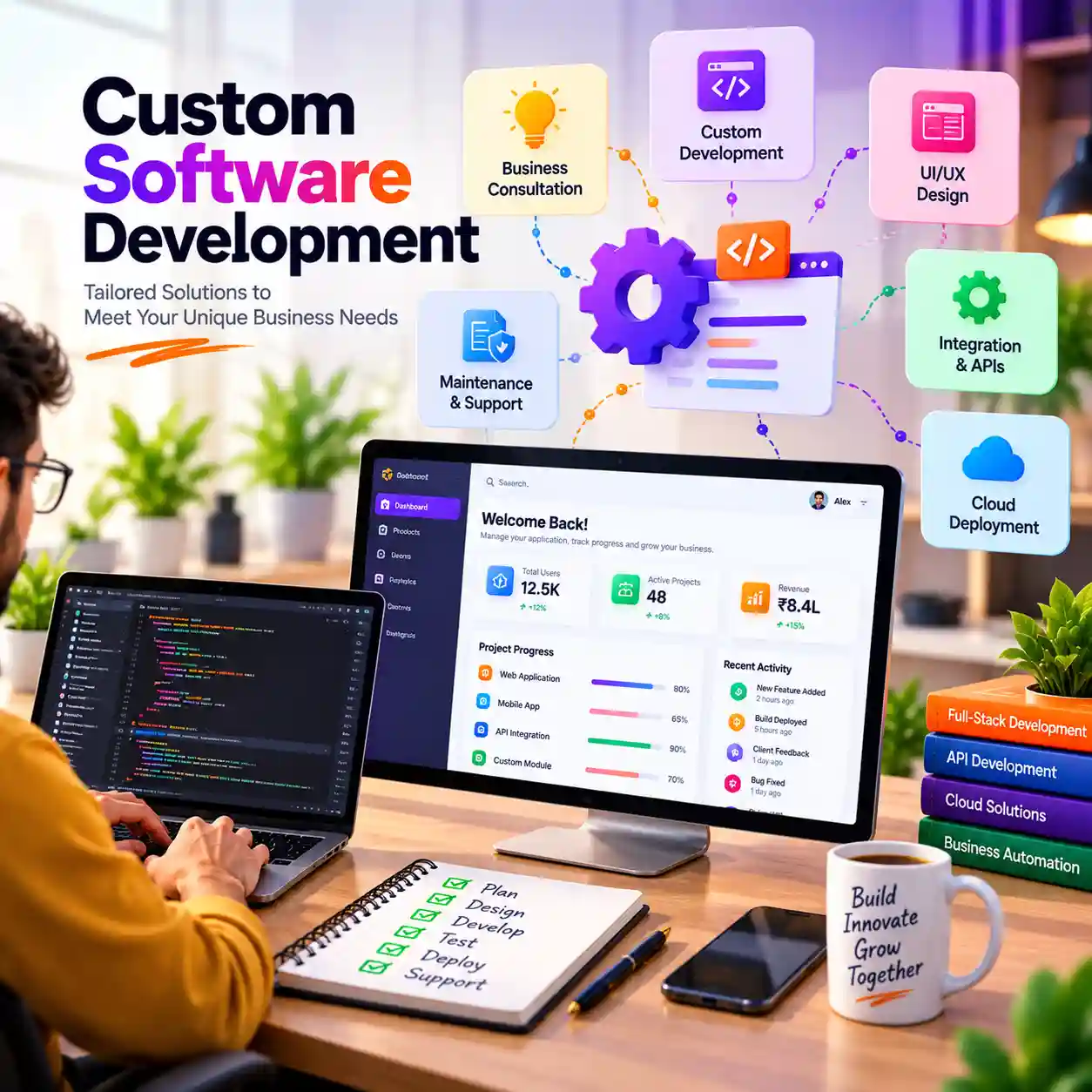
Full-Stack Development Services Introduction
Complete Web Solutions from Frontend Experience to Backend Engineering
Build Every Layer Together
A successful digital product needs more than an attractive interface. It also needs application logic, structured data, secure user access, communication between systems and an architecture that can support future improvements. Full-stack development brings these application layers together to create a connected software solution.
Of2On provides full-stack development services for businesses that need websites, web applications, portals and custom digital platforms. Our approach considers both the user-facing experience and the server-side systems that make an application work. Depending on project requirements, this may include interface development, backend programming, database design, API development, authentication, integrations, testing and deployment preparation.
On the frontend, the focus is on clear, responsive and accessible interfaces that help users complete tasks across supported devices. On the backend, the application needs organized business logic, secure data handling, reliable APIs and maintainable database operations.
Full-stack development also involves understanding how these layers communicate. A form submission, account login, product search, payment workflow or dashboard report may involve the frontend, backend, database and external services. Each part must work together and handle errors appropriately.
Every project begins with understanding the business objective, users, required features, existing systems and technical constraints. Based on this assessment, the team can recommend a suitable technology stack and application structure rather than forcing every project into the same setup.
Whether you are planning a new web application, improving an existing platform, building a customer portal or connecting business systems, Of2On can help define and develop a solution around your requirements.
One Connected Approach to Application Development
Bring User Experience, Business Logic and Data Together
Connect the Application Layers
A full-stack application connects the interface users interact with to backend services that process requests and manage information. When these parts are planned together, the result can be easier to maintain, extend and integrate with other business systems.
The frontend presents information and provides the controls users need. It may include navigation, forms, dashboards, search, account pages, product listings and interactive components. Frontend development considers responsive behavior, loading states, validation feedback, accessibility and consistent design.
The backend handles application rules and processes. It may manage user accounts, permissions, workflows, notifications, file handling, payment integration and communication with external services. Backend code should be structured so important business rules remain understandable and testable.
The database stores information used by the application. Its structure should reflect relationships between users, records, transactions and business entities. Validation, indexing, access controls and query design support reliable data operations.
APIs provide a defined way for the frontend, mobile applications and external systems to communicate with backend services. API design considers authentication, authorization, request validation, response formats, error handling and versioning where needed.
Third-party integrations may involve payment gateways, email services, maps, analytics, cloud storage or notifications. Each integration should be assessed for compatibility, security, licensing, provider limits and ongoing cost.
Of2On approaches these layers as parts of one application rather than disconnected tasks, with the objective of creating a solution where interface, logic, data and integrations work together around business needs.
Full-Stack Solutions for Different Business Needs
Explore the types of applications we can help build.
Business Websites
Custom Web Apps
Customer Portals
Admin Dashboards

E-Commerce Apps
Job Portals
Real Estate Apps
Booking Systems
Learning Platforms
Service Platforms
Inventory Systems
API-Driven Apps
SaaS Platforms
App Modernization
Full-Stack Development Services
Plan, build and connect every layer of your application.
Frontend Development
Backend Development
Database Engineering
API Development
Custom Web Apps
Admin Dashboards
E-Commerce Apps
User Authentication
Application Testing
Deployment Support
Core Capabilities of Our Full-Stack Development Services
Develop responsive user interfaces with clear navigation, reusable components, form validation and consistent behavior across supported screen sizes.
Build server-side application logic for accounts, business rules, workflows, data processing and communication with other services.
Plan data structures, relationships, constraints and indexes to support maintainable information management.
Create structured APIs that allow web interfaces, mobile applications and approved external systems to communicate with backend services.
Implement suitable login, account management, roles and permissions so users can access authorized features and information.
Develop management interfaces for reviewing records, controlling workflows, managing content and accessing operational information.
Connect approved services such as payment gateways, email, maps, storage and notifications after assessing their requirements.
Develop product catalogs, carts, order management and payment-related application flows with appropriate validation.
Build search and filtering experiences that help users find and manage application information.
Plan file uploads, storage, access permissions, validation and delivery using services approved for the project.
Test important flows, validation rules, API behavior, permissions, responsive interfaces and error scenarios.
Review queries, application structure, caching opportunities, asset delivery and monitoring needs based on project requirements.
Prepare configuration, environment variables, database setup, server requirements and release checks for the selected hosting environment.
Plan bug fixes, dependency updates, technical improvements and new features according to the agreed maintenance scope.
Full-Stack Development Solutions We Provide
Choose the development support your project requires.
Frontend Web Development
Create responsive web interfaces.
Backend Application Development
Develop logic, workflows and services.
Database Design and Development
Structure application data and access.
API Development and Integration
Connect app layers and services.
Custom Web Applications
Build software for business workflows.
Admin Panels and Dashboards
Give teams tools for records and tasks.
E-Commerce Development
Plan product and order workflows.
Portal and User Management
Build access for defined user groups.
Application Modernization
Review improvements and integrations.
Testing and Deployment Support
Validate workflows and release setup.
Technologies and Components in Full-Stack Development
Select suitable tools for your application requirements.
Build
Innovate
Grow
Innovate
Grow
Backend Development
Database Engineering
API Development
Authentication
Admin Dashboards
E-Commerce Apps
Cloud and Hosting
Business Workflows
Quality Testing
Application Security
Deployment Planning
Why Choose Of2On for Full-Stack Development
Understand Needs
We clarify business objectives, user needs, required features and constraints before defining the development scope.
✓
Plan App Layers
We consider how the frontend, backend, database and integrations work together in the proposed application.
Strategy First
Choose a Stack
Technology choices depend on the project requirements, existing systems, maintainability needs and verified capabilities.
</>
Connect Data
We assess database requirements and supported interfaces before planning integrations with other systems.
🖍️
Aa
🖼️
Consider User Access
We plan authentication and permissions so users can access the records and actions appropriate to their roles.
HTML
CSS
JS
✓
Test Workflows
We consider application flows, validation, permissions, responsive interfaces and failure cases during quality checks.
✓
Plan for Maintenance
We consider documentation, operational ownership, updates and future enhancements within the agreed scope.
Strategy First
Full-Stack Development Highlights
Key components across your application project.
Build
Innovate
Grow
Innovate
Grow
Requirements
Frontend Design
Backend Logic
Database Planning
API Development
User Authentication
Admin Dashboards
Business Workflows
Third-Party Links
File Handling
Testing and QA
Query Review
Deployment Prep
Security Planning
Maintenance
Our Full-Stack Development Process
A structured path from project discovery to application handover.
Project Discovery
Understand business objectives, users, workflows, required features, existing systems and constraints. Identify essential functions, acceptance criteria and dependencies.
Project Discovery
Understand business objectives, users, workflows, required features, existing systems and constraints. Identify essential functions, acceptance criteria and dependencies.
Learn more
Architecture Plan
Plan the frontend, backend, database and integrations together. Assess technology options, data relationships, APIs, authentication, permissions, hosting and deployment needs.
Architecture Plan
Plan the frontend, backend, database and integrations together. Assess technology options, data relationships, APIs, authentication, permissions, hosting and deployment needs.
Learn more
UI and Frontend
Design user journeys and implement agreed interfaces. Consider page structure, responsive layouts, reusable components, forms, validation, dashboards and accessibility.
UI and Frontend
Design user journeys and implement agreed interfaces. Consider page structure, responsive layouts, reusable components, forms, validation, dashboards and accessibility.
Learn more
Backend and Database
Develop server-side features, business rules and data operations. Work may include project setup, database relationships, authentication, APIs and request validation.
Backend and Database
Develop server-side features, business rules and data operations. Work may include project setup, database relationships, authentication, APIs and request validation.
Learn more
API and Integrations
Connect application layers and approved external services. Assess provider documentation, credentials, failure behavior, licensing and technical requirements.
API and Integrations
Connect application layers and approved external services. Assess provider documentation, credentials, failure behavior, licensing and technical requirements.
Learn more
Testing and Quality
Check functional flows, forms, APIs, roles, permissions, responsive layouts and edge cases against the agreed requirements. Track and address identified issues.
Testing and Quality
Check functional flows, forms, APIs, roles, permissions, responsive layouts and edge cases against the agreed requirements. Track and address identified issues.
Learn more
Deployment Handover
Review environment configuration, data and storage setup, secrets, access, build checks and release readiness. Prepare technical documentation and handover information.
Deployment Handover
Review environment configuration, data and storage setup, secrets, access, build checks and release readiness. Prepare technical documentation and handover information.
Learn more
Maintenance Planning
Discuss bug fixes, dependency updates, monitoring, backup responsibilities and future improvements according to the agreed support scope.
Maintenance Planning
Discuss bug fixes, dependency updates, monitoring, backup responsibilities and future improvements according to the agreed support scope.
Learn more
Full-Stack Development Services Overview
Understand the frontend, backend, database and integration layers.
Full-stack development is the process of building connected parts of a software application, including the user interface, server-side logic, database and application integrations. It brings major technical layers together so users can interact with information and complete business tasks through one coordinated system.
The frontend is the part of an application that users see and interact with. It includes page layouts, navigation, forms, buttons, tables, dashboards, search interfaces and other interactive elements. Frontend development should consider usability, accessibility, responsive behavior, loading states, error messages and consistent presentation across supported devices.
The backend processes application requests and enforces business rules. It may handle user accounts, permissions, transactions, notifications, file operations, reporting and communication with other systems. A maintainable backend separates responsibilities into suitable components and validates incoming requests before processing them.
The database stores application information and defines how records relate to one another. A well-planned database considers entities, relationships, constraints, indexes and data integrity. Design should reflect actual business workflows and avoid unnecessary duplication. Query performance and access permissions also need attention as the application grows.
APIs allow different parts of a software system to exchange information. A web frontend may call backend endpoints, a mobile app may use the same services and an approved external system may exchange data through a defined integration. API design should specify request formats, response structures, authentication, authorization, validation, error handling and versioning where appropriate.
Full-stack development begins with requirements analysis. The team needs to understand what the application should accomplish, who will use it, which workflows matter and what constraints apply. Discovery helps distinguish essential features from optional enhancements and supports a realistic development scope.
Application architecture defines how components are organized and communicate. Depending on the project, an application may use a monolithic architecture, modular structure or distributed services. The right choice depends on complexity, team capabilities, expected scale, integration needs and operational requirements. More complex architecture is not automatically better.
Frontend technology selection depends on the required interface, existing systems, team skills and project constraints. Backend technology selection should consider business logic, ecosystem, hosting environment, integration requirements and maintenance needs. Database selection depends on data structure, transaction needs, query patterns and operational constraints. No single stack suits every project.
Authentication confirms a user’s identity, while authorization determines which actions and records that user can access. Applications may support administrators, customers, employees, vendors or managers. Role and permission rules should be enforced on the backend, not only by hiding interface elements.
Input validation is important at every application boundary. Forms, APIs, file uploads and external service responses should be checked before use. Validation helps prevent malformed data and unexpected behavior. Error messages should provide useful guidance without exposing internal implementation details.
File and media handling may include document uploads, profile images, product images or other business files. The implementation should consider allowed types, size limits, safe filenames, storage permissions, access control, retention and delivery. Sensitive files should not be made public for convenience.
Third-party integrations can extend an application with payments, email, maps, cloud storage, analytics and notifications. Before implementation, assess provider documentation, API availability, authentication, pricing, rate limits, data handling and failure behavior. Credentials should be stored securely and never exposed in frontend code or public repositories.
Admin dashboards provide authorized staff with tools to manage users, content, transactions, settings and business records. Their design should reflect actual administrative workflows and permissions. Reports should be based on correctly defined data and communicate the meaning and limits of displayed information.
E-commerce applications may combine product catalogs, search, cart operations, checkout, payment gateway communication, order management and customer accounts. Payment status must be verified through the approved gateway flow and backend validation. A browser-side success message is not sufficient proof of payment.
Testing and quality assurance help confirm that application features behave as expected. Functional testing checks workflows, API testing checks service behavior, permission testing checks access boundaries and responsive testing checks supported screen sizes. Edge cases include missing data, invalid inputs, duplicate submissions, unavailable services and interrupted requests.
Performance depends on frontend assets, server processing, database queries, network requests, caching and hosting resources. Optimization should be based on measurement. Possible techniques include reducing unnecessary requests, optimizing images, using indexes, reviewing slow queries, paginating large datasets and caching only when freshness requirements allow.
Application security should be considered throughout development. Relevant areas include authentication, authorization, input validation, output encoding, CSRF protection where applicable, safe file uploads, secrets management, dependency updates, secure transport and careful error handling. Security review should fit the application’s data and risk profile.
Deployment preparation involves configuring the production environment, application settings, database connections, storage, scheduled tasks, background workers and monitoring as required. Environment-specific secrets should be managed securely. Backup and recovery expectations should be defined for important data.
Version control supports collaboration and change tracking. Clear branching and review processes help teams understand changes, test updates and reduce unreviewed code reaching production. Documentation should describe setup steps, dependencies, configuration and operational responsibilities.
Maintenance continues after release. Frameworks and dependencies may need updates, provider APIs may change, workflows may evolve and users may request features. A maintenance plan should define ownership, support expectations, backups, monitoring and how enhancements are prioritized.
Full-stack development is the coordinated planning, implementation, integration, testing and maintenance of a complete application. Results depend on clear requirements, suitable architecture, secure data handling, reliable integrations and a development process that considers actual users.
Of2On’s full-stack development approach focuses on understanding the business requirement and building connected application layers around it. Depending on approved scope, services may include frontend development, backend programming, database design, API development, admin dashboards, portals, third-party integration assessment, testing, deployment preparation and maintenance.
The goal is to create a practical, maintainable application that supports organizational workflows and provides a suitable foundation for future enhancements.
Full-Stack Project Planning Checklist
Important areas to confirm before development begins.
Business Objectives
Users and Roles
Pages and Modules
Functional Scope
Quality Requirements
Responsive UI Needs
Backend Workflows
Database Design
API Requirements
Authentication Needs
Admin Dashboard
External APIs
File Storage Needs
Payment Workflows
Security and Privacy
Testing Criteria
Performance Needs
Hosting Environment
Backup and Recovery
Maintenance Plan
Full-Stack Development Consultation
Plan your next web application with Of2On.
Develop New Applications and Improve Existing Platforms
Discuss interfaces, APIs, enhancements, testing and maintenance.